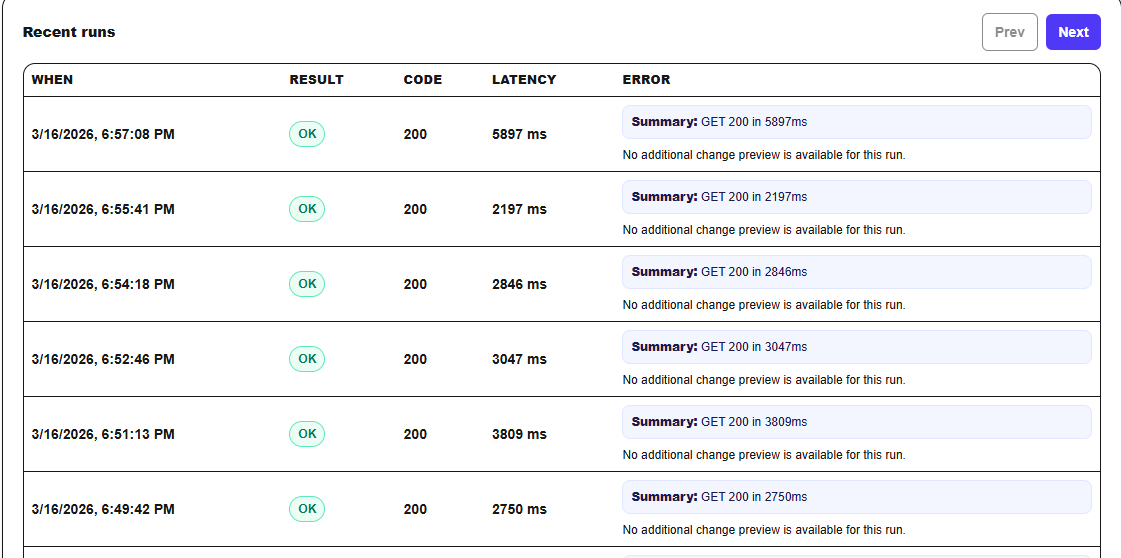
When people hear “HTTP uptime monitoring,” they often think of one simple question:
Is the website up or down?
That is part of it, but it is not the full picture.
HTTP uptime monitoring is about knowing when a website, page, or endpoint stops responding the way it should. It helps you catch failures earlier, understand when something starts going wrong, and avoid finding out from frustrated users, missed conversions, or broken workflows after the damage is already done.
In other words, HTTP uptime monitoring is not just about availability. It is about visibility.
It gives you a clearer way to know when something important on the web is no longer behaving normally.
What HTTP uptime monitoring actually means
HTTP uptime monitoring checks whether a website or endpoint can be reached and whether it is responding in an acceptable way.
That may sound technical at first, but the idea is practical.
A page loads or it does not.
An endpoint responds or it does not.
A service returns the kind of response you expect or it starts failing.
That is what makes HTTP uptime monitoring so useful. It watches one of the most important signals of web reliability: whether the thing you depend on is actually responding when it should.
For some people, that means a homepage.
For others, it means a login page, checkout page, API endpoint, callback URL, dashboard route, or internal service endpoint that must stay reachable.
If it matters that it responds, HTTP uptime monitoring matters.
Why it matters more than people think
Most website and endpoint problems do not begin with a dramatic outage that is impossible to miss.
Sometimes a service gets slower before it fails.
Sometimes an endpoint starts returning the wrong status.
Sometimes a page responds, but not in the way it should.
Sometimes a failure affects only one important path while the rest of the site still looks fine.
Sometimes the problem sits there quietly until users start complaining.
That is why HTTP uptime monitoring matters.
It helps you stop relying on luck, scattered manual checks, or customer reports to learn that something is broken. Instead of waiting for a problem to become obvious, you create a way to notice it earlier.
That earlier awareness matters because the sooner you know, the more room you usually have to respond well.
HTTP uptime monitoring is not only for “big companies”
One of the easiest mistakes to make is assuming uptime monitoring is only for large engineering teams or high-scale infrastructure.
It is not.
If you have a website, a public page, an app endpoint, a client-facing service, or any important web address that people depend on, uptime matters. That is true whether you run a growing business, a small service, a client project, an online store, an internal tool, or a personal product.
The size of the company does not determine whether uptime matters.
The importance of the page or endpoint does.
If people need it to work, it is worth watching.
What HTTP uptime monitoring helps you catch
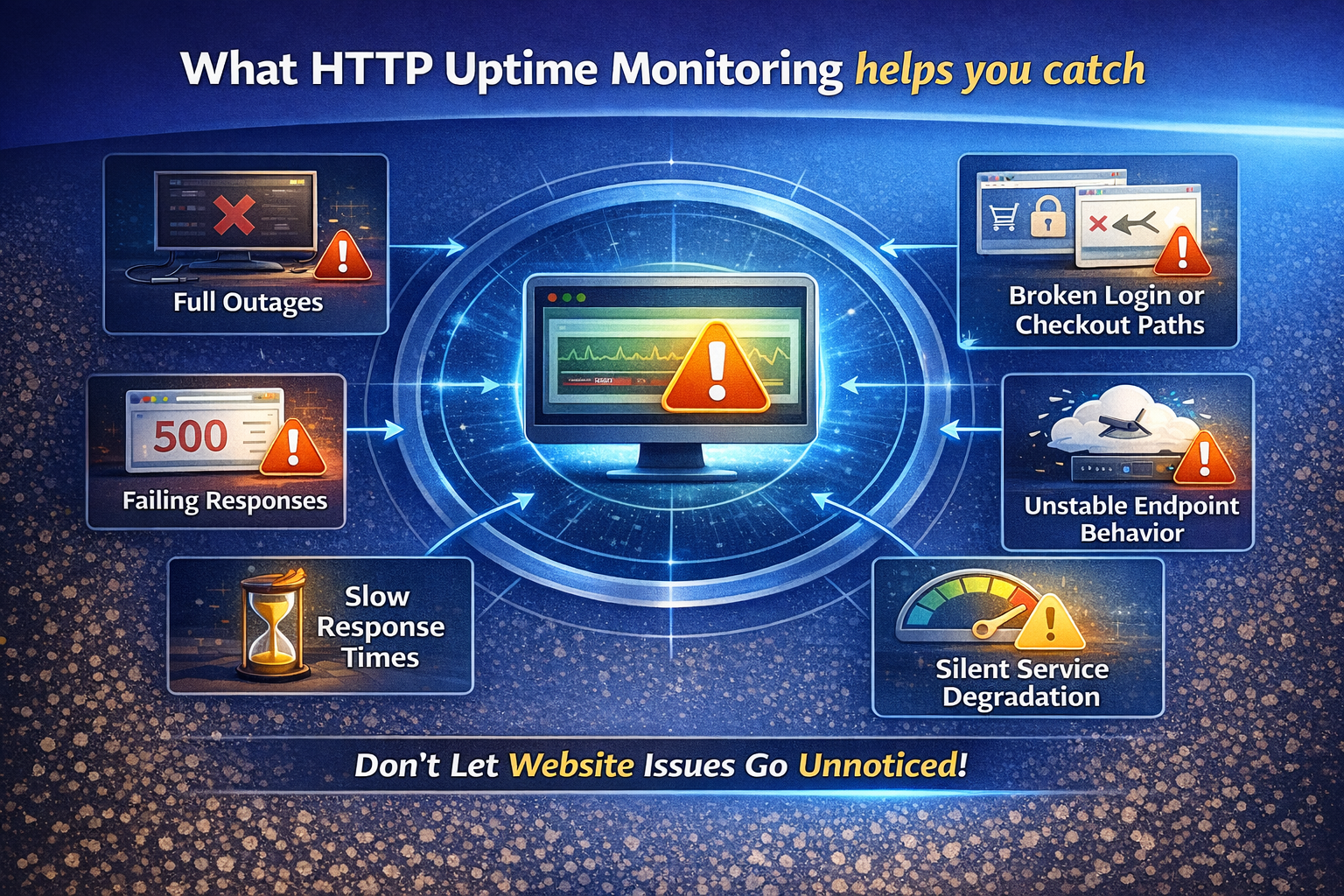
HTTP uptime monitoring helps you catch more than complete downtime.
Full outages
This is the obvious one.
A website stops loading.
An endpoint stops responding.
A page becomes unreachable.
When that happens, you want to know quickly.
Failing responses
Sometimes the service is technically reachable, but it is still failing in an important way. Maybe it returns an error instead of a healthy response. Maybe an endpoint that should work starts returning the wrong result. Maybe a page that should load properly now responds with failure.
That is still a real problem, even if the server itself is technically online.
Broken customer paths
Not every failure affects the whole website equally.
A homepage may load while login fails.
The main site may work while checkout breaks.
A dashboard may respond while a key integration endpoint is down.
A landing page may appear reachable while the deeper action the visitor needs is failing.
HTTP uptime monitoring helps you watch the paths that actually matter instead of assuming the whole system is fine because one page loaded once.
Unreliable behavior over time
Some problems are not permanent. They appear, disappear, and return.
That kind of instability can be just as damaging as a hard outage because it creates confusion, weakens trust, and makes incidents harder to understand. A service that fails intermittently still affects users, still wastes time, and still deserves attention.
Monitoring helps you move from vague suspicion to clearer evidence.
Performance warning signs
Sometimes the first sign of trouble is not failure. It is slowdown.
A page or endpoint may still respond, but much more slowly than normal. That kind of change can be an early signal of overload, infrastructure stress, third-party issues, or degraded user experience.
When you can see latency changes alongside availability checks, you get a more useful picture of what is happening.
Who HTTP uptime monitoring helps
Website owners and product teams
If your website or product is public-facing, uptime is part of trust.
Visitors do not usually care why something is down. They care that it works when they need it. A broken page, a failing login, or an unavailable route can damage confidence quickly, especially when that experience happens at a key moment.
HTTP uptime monitoring helps you stay closer to that reality.
Developers, agencies, and operations teams
When you are responsible for services, client sites, APIs, or web infrastructure, uptime monitoring becomes one of the most practical forms of visibility you can have.
It helps you know when something failed, when it recovered, and when the pattern started. That does not solve every incident by itself, but it gives you a much better starting point for response and review.
Businesses that depend on web conversions
For many businesses, a website is not just a web presence. It is part of the sales path.
If the page that captures leads, processes orders, accepts requests, or moves visitors into action stops working, the problem is not abstract. It affects trust, revenue, and timing directly.
That is why uptime monitoring is not just a technical concern. It is a business concern too.
Teams managing important endpoints behind the scenes
Not everything important is visible to the public homepage.
An API route, webhook endpoint, callback URL, or internal-facing web service can be just as business-critical as a public page. If it fails, other workflows can stall or break even when the top-level site still appears fine.
HTTP uptime monitoring helps bring those dependencies into view.
Why manual checking is not enough
At first, it seems easy to check things yourself.
Open the page.
Refresh it.
Try the endpoint.
Load the route.
See if it works.
That method feels fine until it is not.
You cannot manually check everything all the time.
You cannot depend on memory for every important path.
You cannot assume the one moment you checked reflects the whole day.
You cannot scale awareness by refreshing tabs forever.
Manual checking is useful for confirming a suspicion. It is not a dependable monitoring strategy.
That is the gap HTTP uptime monitoring fills.
It turns “let me keep checking this” into “I will know when this stops behaving normally.”
What makes a good uptime target to monitor
Not every URL matters equally.
The best uptime targets are the ones whose failure would matter most.
That often includes:
- your homepage
- your login route
- your checkout or payment-related page
- your main product or service page
- a key API endpoint
- a client-facing dashboard
- a callback, webhook, or integration route
- any endpoint tied to a critical workflow
The best first target is usually not the most obvious one. It is the one whose failure would hurt the most if nobody noticed quickly.
What HTTP uptime monitoring is not
HTTP uptime monitoring is powerful, but it does not explain everything by itself.
If a page is reachable, that does not automatically mean the whole user experience is healthy.
If a route responds, that does not guarantee every dependent service is fine.
If a check passes, that does not mean there are no deeper issues elsewhere.
That is why uptime monitoring is best treated as a core layer of visibility, not the only layer.
It tells you something essential:
whether a page or endpoint is responding as expected.
That alone is extremely valuable, but it is even stronger when paired with other useful monitoring signals.
Why it works better inside a broader monitoring setup
In real use, web problems do not always arrive in neat categories.
A service issue can overlap with certificate problems.
A page might stay up while public content changes unexpectedly.
An endpoint may be reachable while DNS changes are causing problems elsewhere.
A background task may stop checking in even while the main site still looks normal.
That is why broader monitoring matters.
HTTP uptime monitoring gives you one of the clearest and most foundational signals, but it becomes even more useful when it sits inside a monitoring workflow that can also help you track trust issues, expiry problems, page changes, missed heartbeats, and other website-facing health signals.
That kind of visibility helps you understand not only whether something is wrong, but what kind of wrong you may be dealing with.
Why HTTP uptime monitoring matters for trust
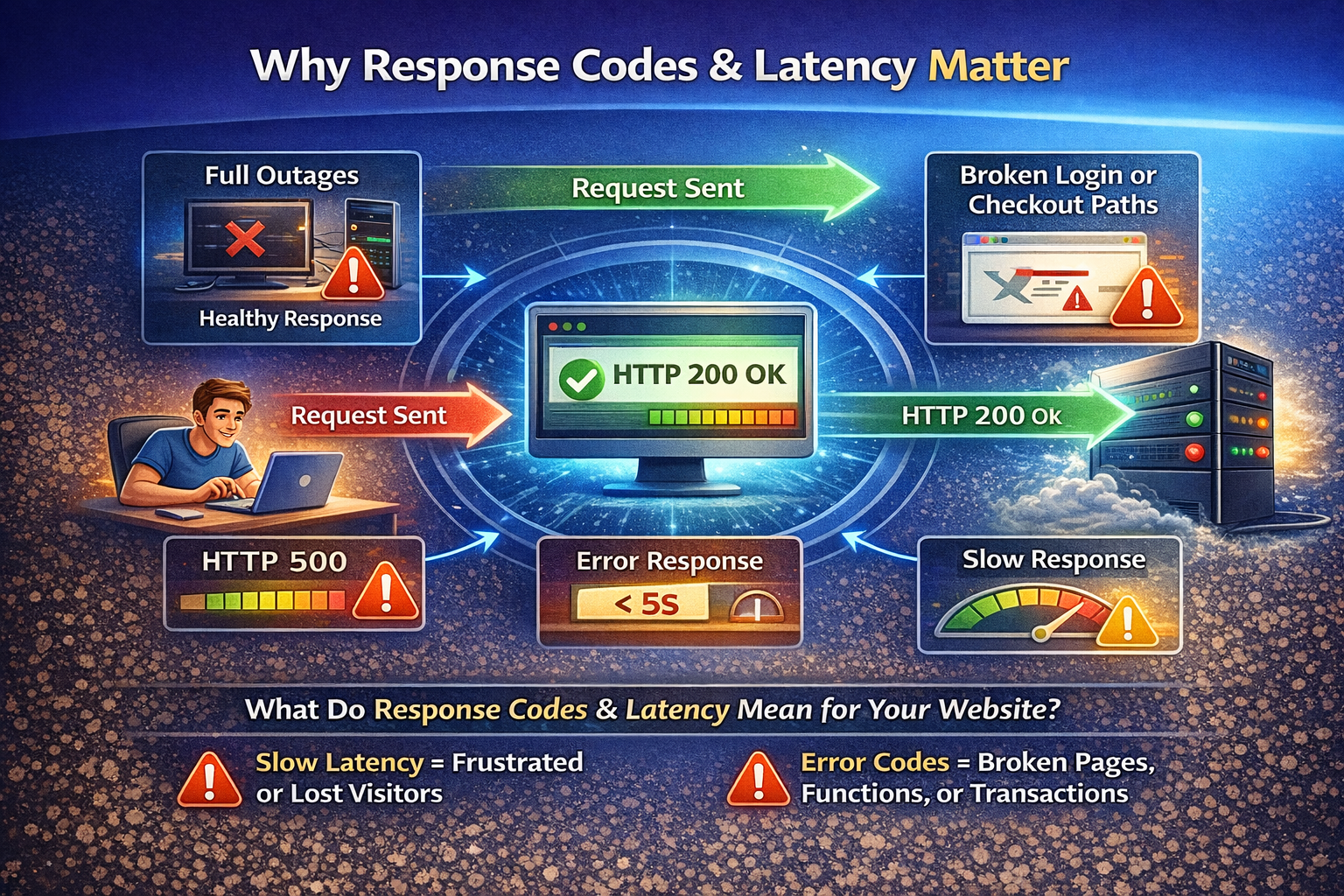
People often think of uptime in purely technical terms.
But from the user’s side, uptime is trust.
A page that fails to load.
A route that returns an error.
A service that is unreliable.
A form that stops working.
A login path that breaks at the wrong time.
All of those experiences shape how people feel about the business behind the service.
If users repeatedly hit failures, trust weakens.
If they reach the site and it works, trust stays stronger.
If problems are caught and fixed earlier, the damage is often smaller.
That is why uptime monitoring belongs in serious operational thinking. It helps protect not only systems, but confidence.
Why it matters for revenue and opportunity too
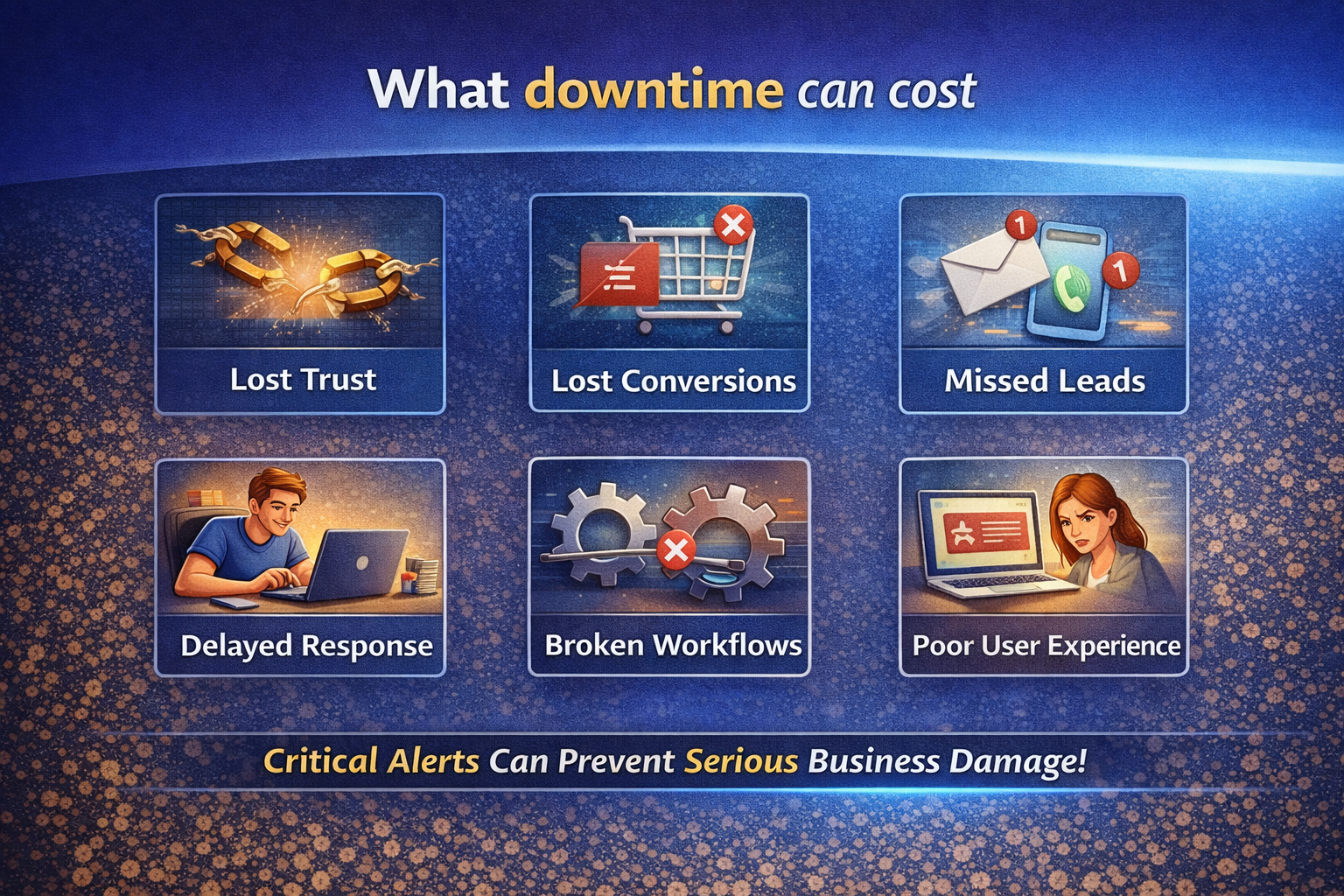
When an important page or endpoint fails, the cost is not always immediate or obvious on a graph.
Sometimes it is a missed signup.
Sometimes it is an abandoned checkout.
Sometimes it is a lead that never converted.
Sometimes it is a workflow that broke quietly behind the scenes.
Sometimes it is an integration that stopped working while nobody noticed.
Those are the kinds of losses that are easy to underestimate because they do not always appear as one dramatic outage headline.
They appear as lost momentum, delayed response, and invisible friction.
HTTP uptime monitoring helps reduce that invisibility.
How to think about starting with Watchtower
The best way to start is simply to choose what matters most.
Ask:
- Which page or endpoint would hurt the most if it failed today?
- Which route is most tied to trust, conversions, or customer experience?
- Which endpoint do I never want to find out about too late?
- Which part of my service do people depend on most?
That is usually where the value becomes clear first.
Start there.
Get visibility there.
Then expand as your needs grow.
That approach is usually more useful than trying to monitor everything at once.
Why we built HTTP uptime monitoring into Watchtower
At Watchtower, we believe monitoring should help you see important problems earlier without forcing you into a fragmented, overly complicated workflow.
HTTP uptime monitoring belongs at the center of that idea because availability is one of the first things people need to know. If a website, page, or endpoint stops responding properly, that is not a minor detail. It is a meaningful signal that something needs attention.
That is why HTTP monitoring is such a core part of practical web visibility.
It helps you know when something stopped working.
It helps you react sooner.
It helps you rely less on guesswork.
It helps you protect trust, traffic, and the workflows that depend on the web staying reachable.
Final thought
HTTP uptime monitoring is not just a green-or-red badge.
It is a way to stay aware of whether the pages and endpoints that matter are actually doing their job.
It helps you catch problems earlier.
It helps you reduce blind spots.
It helps you respond faster when something stops working the way it should.
And when your website, endpoint, or service matters to users, customers, or your own operations, that kind of visibility is not optional for long.
It becomes part of working seriously on the web.
That is why HTTP uptime monitoring matters.
And that is what it explains.