SSL expiry problems are easy to underestimate until they become impossible to ignore.
A certificate looks fine right up until it does not. One day everything loads normally. The next day visitors start seeing browser warnings, trust signals break, and confidence drops immediately. That is what makes SSL expiry monitoring so important. It helps you stay ahead of certificate problems before they turn into public trust problems. For us, this is not just another technical checkbox. It is one of the clearest ways to protect the experience people have when they reach your website or service.
What SSL expiry monitoring actually means
SSL expiry monitoring is the practice of tracking the validity period of your SSL certificate so you know before it expires. Instead of waiting for a browser warning, a failed connection, or a support complaint, you give yourself advance visibility into a problem that has a deadline built into it.
That matters because certificates do not usually fail in a gradual, forgiving way from the visitor’s point of view. When a certificate expires, the experience can go from trusted to alarming very quickly. Users may see warnings, abandon the page, hesitate to continue, or assume the site is unsafe even if the underlying issue is simply that the certificate renewal was missed.
That is why SSL expiry monitoring matters. It helps you avoid finding out too late.
Why expired certificates are a bigger problem than they look
When people think about monitoring, they often think first about uptime. They think about a site being up or down.
But trust issues can be just as damaging.
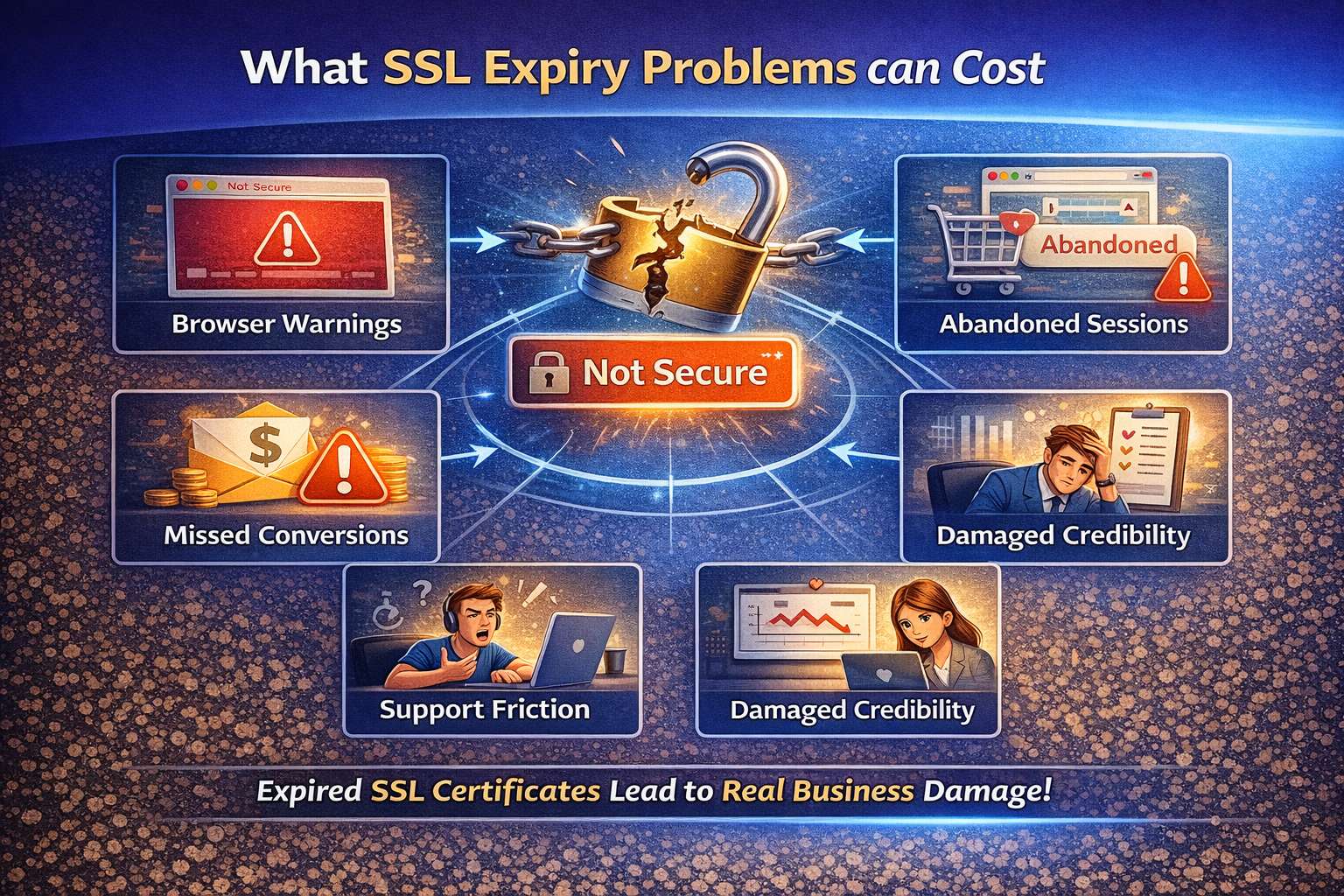
A website may still be technically reachable, but if the browser warns visitors that the connection is not secure, the damage starts immediately. People hesitate. Some leave. Some stop halfway through. Some decide they should not continue at all. A page that looks risky is often treated as risky, whether the underlying service is otherwise fine or not.
For businesses, that can mean lost trust, lost conversions, interrupted signups, abandoned checkouts, or support friction that should never have happened in the first place. For agencies, operations teams, and developers, it can mean unnecessary incident response around a problem that should have been caught long before it reached the user. Watchtower positions SSL monitoring exactly around that risk: staying ahead of certificate expiry and trust-related issues before your users run into browser warnings.
SSL expiry monitoring is really about trust
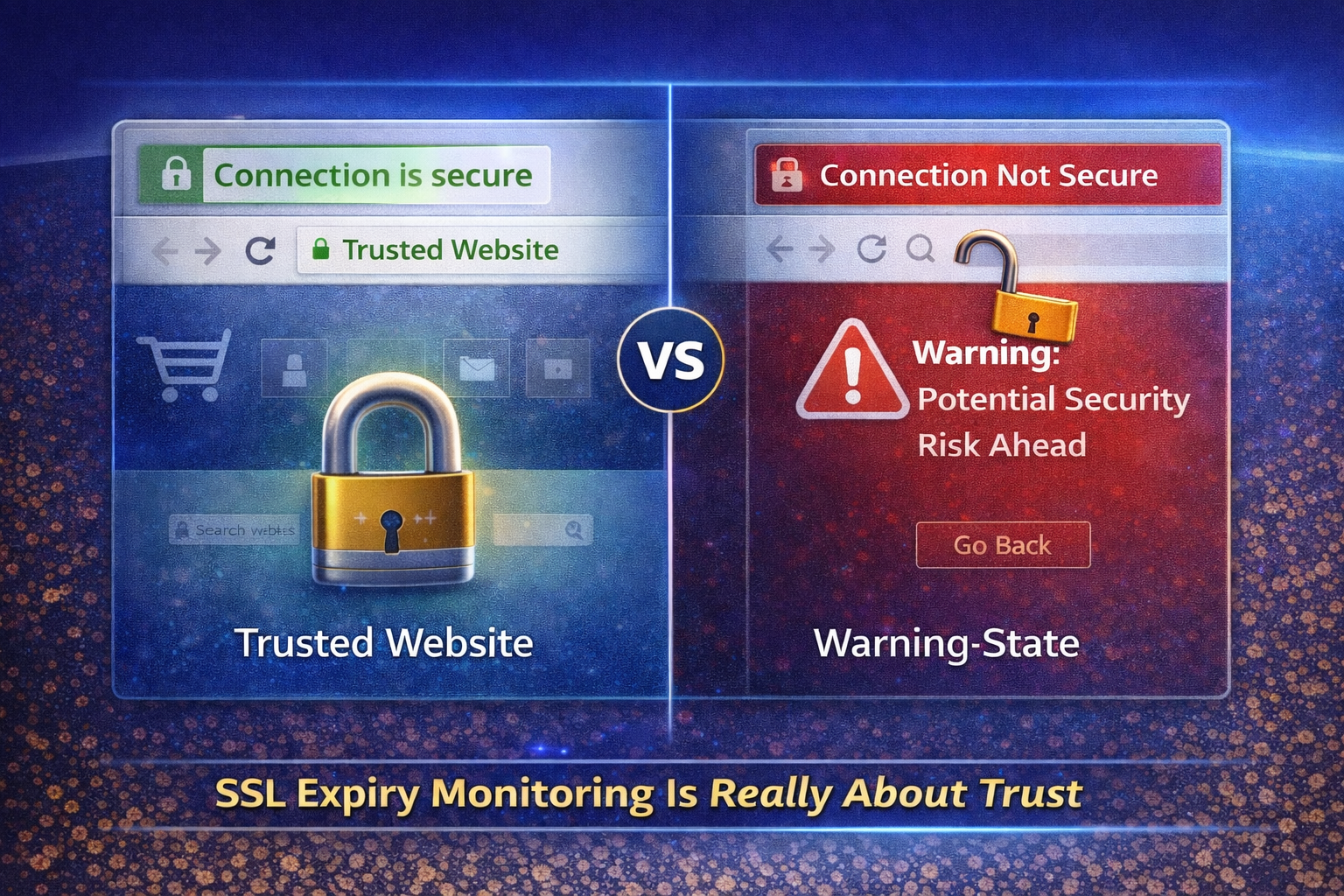
At Watchtower, we do not look at SSL expiry as a narrow technical detail. We treat it as part of trust.
That is because certificates live at the point where security expectations and real user experience meet. People may not know the full mechanics of TLS, but they do understand the feeling of a warning page. They understand the feeling of something looking wrong. They understand when a site no longer feels safe to continue using.
That is why SSL expiry monitoring belongs in practical website monitoring. It is not only about avoiding a date on a certificate calendar. It is about protecting the confidence people have in your website, your product, and your service when they arrive.
Who SSL expiry monitoring helps
SSL expiry monitoring is useful for more people than many assume.
It helps website owners who need their public site to stay trusted.
It helps businesses whose conversions depend on visitors feeling safe enough to continue.
It helps agencies managing multiple client properties where one missed renewal can become an embarrassing and costly issue.
It helps developers and operations teams who want advance visibility into certificate-related risk instead of learning about it after trust has already been damaged.
It helps anyone responsible for a web property where browser trust matters, which is to say almost everyone operating seriously on the web.
What can happen when an SSL certificate expires
An expired certificate can create several layers of damage at once.
The first is the obvious one: browser warnings. That alone is enough to stop many visitors.
The second is trust loss. Even if the issue is temporary, the impression it creates can last longer than the incident itself.
The third is workflow interruption. Logins, dashboards, signups, purchases, and normal browsing behavior can all be affected because users are unwilling to continue through a warning page.
The fourth is avoidable fire-fighting. Instead of calmly renewing before expiry, a team ends up reacting under pressure after the problem is already visible.
This is exactly why expiry monitoring deserves more attention than it sometimes gets. The problem is predictable. The date exists in advance. The damage is avoidable. That makes missing it especially painful.
Why manual tracking is not dependable enough
Some teams still handle certificate awareness through reminders, spreadsheets, calendar notes, or memory.
That can work for a while, especially when there are only one or two domains to think about. But it becomes less dependable as the number of websites, services, environments, or responsibilities grows.
Manual tracking is easy to forget.
Calendar reminders get buried.
Ownership becomes unclear.
Someone assumes somebody else already handled it.
A renewal that felt far away suddenly is not.
That is exactly the kind of problem monitoring is meant to solve.
SSL expiry monitoring replaces vague awareness with clear visibility. Instead of hoping the date is remembered in time, you create a system that keeps watch over it.
Why this matters for businesses
For businesses, SSL expiry is not just an infrastructure problem. It is a credibility problem.
If someone reaches your website and sees a browser warning, they are not thinking about certificate lifecycles. They are thinking about whether they should trust what they are seeing. They are thinking about whether they should continue. They are thinking about whether the business behind the site looks dependable.
That makes SSL expiry monitoring directly relevant to trust, traffic, and revenue.
A certificate problem at the wrong time can affect:
- lead capture
- signups
- purchases
- support load
- brand confidence
- visitor willingness to continue
That is why we see SSL monitoring as part of a serious monitoring workflow, not as a side detail.
Why this matters for agencies and teams managing multiple properties
SSL expiry monitoring becomes even more valuable when one team is responsible for more than one website or service.
Agencies may manage multiple client domains.
Operations teams may oversee several environments.
Growing businesses may have multiple services, subdomains, or web properties.
Internal ownership may be split across different people and workflows.
In those situations, expiry risk becomes easier to miss because responsibility is spread out. Monitoring helps bring that risk back into view. It gives teams a practical way to stay ahead of deadlines that are easy to overlook when attention is divided.
That is one reason Watchtower is built around multiple monitor types, practical workflow visibility, recent runs, and alert delivery, rather than treating monitoring like isolated one-off checks.
SSL expiry monitoring is not the same as uptime monitoring
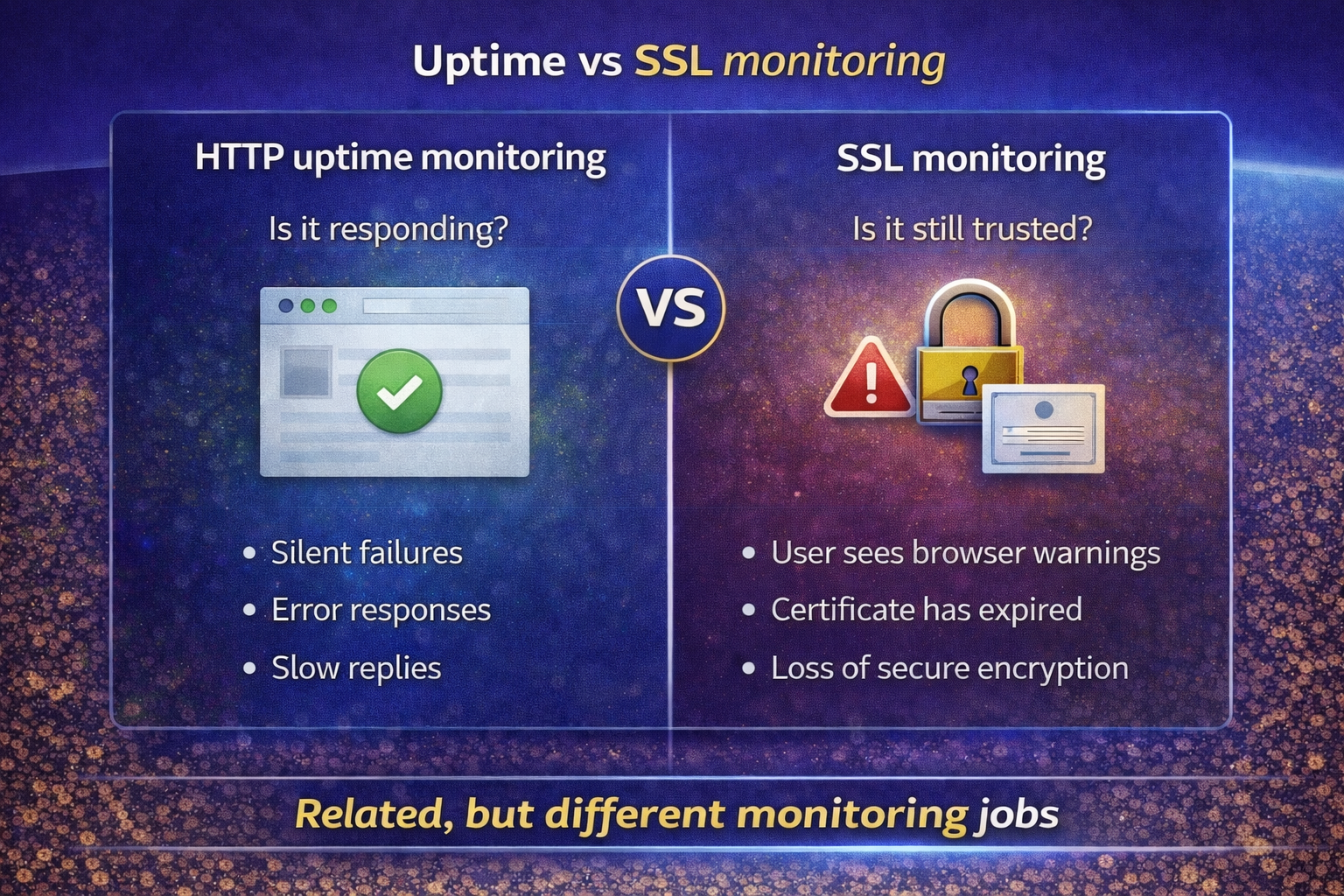
It is important not to confuse these categories.
HTTP uptime monitoring helps you know when a website or endpoint stops responding or starts failing expected checks.
SSL expiry monitoring helps you know when certificate validity is approaching a trust problem.
Those two things are related, but they are not the same.
A site can be up while still having a certificate problem.
A page can load while still showing trust warnings.
An endpoint can remain technically available while the user experience becomes risky.
That is exactly why broader monitoring matters. Different kinds of problems need different kinds of visibility. Watchtower’s live product structure reflects that clearly by separating HTTP uptime, SSL monitoring, domain expiry, DNS, page change, heartbeat, email health, SEO essentials, and security headers into distinct monitor types that cover different risks.
What SSL expiry monitoring helps you do
Good SSL expiry monitoring helps you do a few important things well.
It helps you know that a renewal deadline is approaching.
It helps you reduce the chance of trust warnings reaching users.
It helps you stay ahead of avoidable certificate incidents.
It helps you protect the visitor experience instead of reacting after it breaks.
It helps you treat browser trust as an operational responsibility rather than an afterthought.
That is the real value. Not just seeing a date, but keeping that date from turning into a public problem.
Why this is especially important for customer-facing pages
Some pages carry more trust weight than others.
A homepage matters.
A login page matters.
A billing page matters.
A dashboard matters.
A checkout page matters.
Any page where a visitor is expected to continue, sign in, submit information, or make a decision matters.
If a browser warning appears on a page like that, the damage can be immediate. Even a short interruption can change how people perceive the reliability of the product or company behind it.
That is why SSL expiry monitoring is one of the clearest forms of trust protection you can put in place.
Why we include SSL monitoring in Watchtower
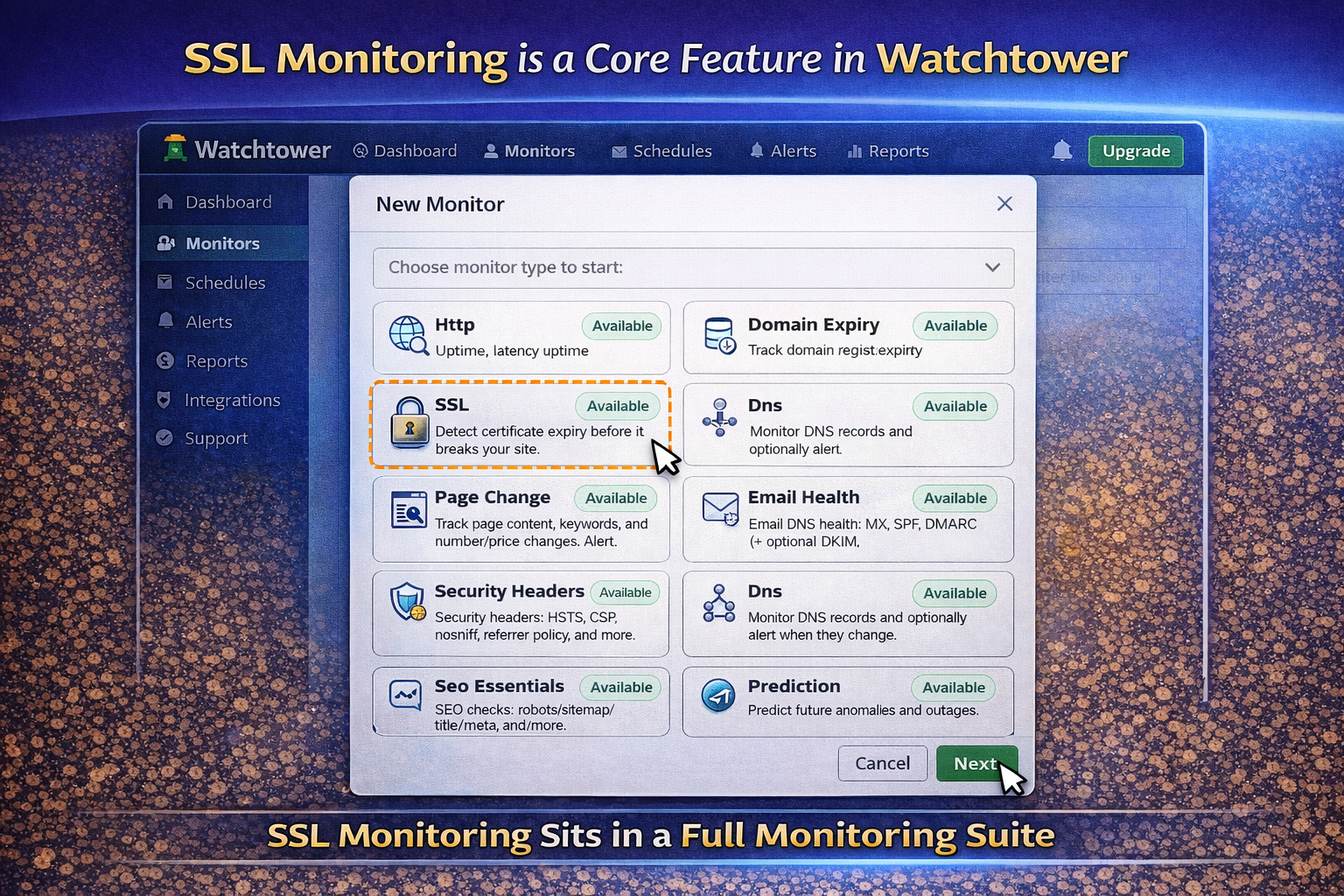
We built Watchtower to help people catch important website, service, and public-web issues earlier with clearer checks, useful alerts, and dependable visibility. SSL monitoring belongs naturally inside that because certificate expiry is one of the most preventable trust problems a web property can run into.
That matters because SSL expiry does not live in isolation in real workflows. A team that cares about certificate trust often also cares about uptime, domain expiry, DNS stability, page changes, and alert delivery. Putting those concerns into one practical monitoring workflow makes it easier to keep the bigger picture in view.
How to think about starting
If you are just getting started, begin with the domains and services where trust matters most.
Start with the web properties that would cause the biggest problem if a browser warning appeared tomorrow.
That may be:
- your main website
- your product domain
- your login or account area
- your client-facing dashboard
- your checkout-related pages
- any domain tied closely to trust and conversion
The goal is not to monitor everything at once. The goal is to make sure the properties that matter most are not left exposed to a preventable expiry surprise.
Final thought
SSL expiry monitoring is not just about certificates.
It is about avoiding trust problems before your visitors see them.
It is about protecting the moment when someone reaches your website and decides whether it feels safe to continue.
It is about replacing “we should remember that renewal” with a clearer system that keeps watch for you.
When your website matters, trust matters.
And when trust matters, staying ahead of certificate expiry matters too.
That is why SSL expiry monitoring is worth taking seriously.
And that is what it explains.