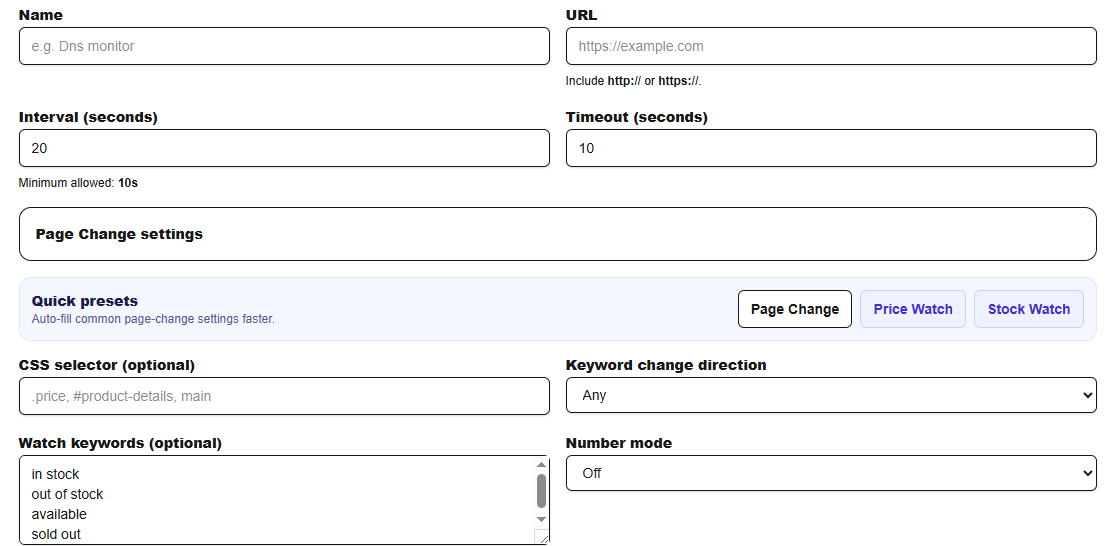
When most people hear “page change monitoring,” they think of a simple idea: a webpage changes, and you get notified.
That is true, but it is also far too small a definition for how useful it can be.
Page change monitoring is for staying aware of the updates that matter before they cost you time, trust, revenue, or opportunity. It helps you stop relying on manual checking, guesswork, and luck. Instead of repeatedly opening the same pages to see whether anything changed, you can let Watchtower keep watch for you and alert you when something important is different.
That matters more than many people realize.
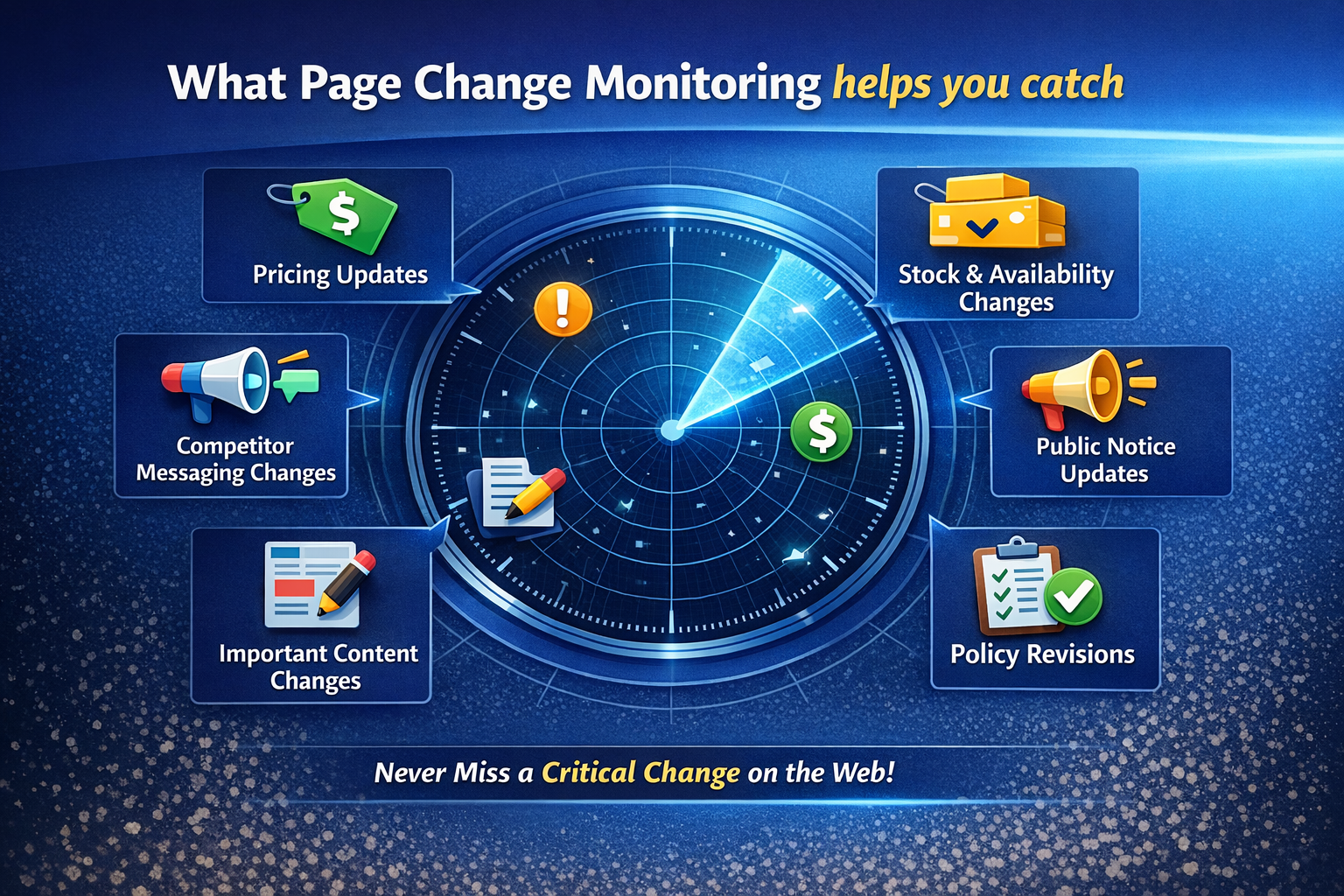
Pages on the web change quietly all the time. Prices move. Products go out of stock. Competitors change messaging. Public notices are updated. Policy language gets revised. Landing pages are rewritten. Important information appears, disappears, or shifts without any announcement. By the time most people notice, the useful moment to respond may already be gone.
That is what page change monitoring is for: helping you notice sooner, act faster, and stay informed without having to sit and watch pages manually.
Why page change monitoring matters
The web does not stay still.
If you run a business, manage a website, sell online, watch competitors, follow public notices, or make decisions based on information published on the web, then page changes can affect you directly. Sometimes the change is obvious. Sometimes it is just one sentence, one number, one offer, one availability update, or one piece of wording that suddenly matters a lot.
The problem is not that web pages change. The problem is that important changes are easy to miss.
Manual checking sounds simple at first, but it breaks down quickly. You forget to check. Someone else assumes you already checked. You check too late. You check inconsistently. You only notice changes after they have already influenced customers, decisions, campaigns, pricing, or operations.
That is where page change monitoring becomes powerful. It gives you a clearer way to watch the pages that matter without turning it into a repetitive daily task.
What page change monitoring actually helps you do
At Watchtower, we see page change monitoring as a practical visibility tool.
It helps you:
- keep watch over important public pages without refreshing them all day
- notice meaningful updates earlier
- reduce blind spots in your workflow
- stay aware of changes that influence decisions
- react faster when content, pricing, stock, or messaging shifts
In other words, it helps you move from “I hope I notice when this changes” to “I will know when this changes.”
That difference is bigger than it sounds.
It is not only for technical teams
One of the biggest mistakes people make is assuming page change monitoring is only for developers or advanced technical users.
It is not.
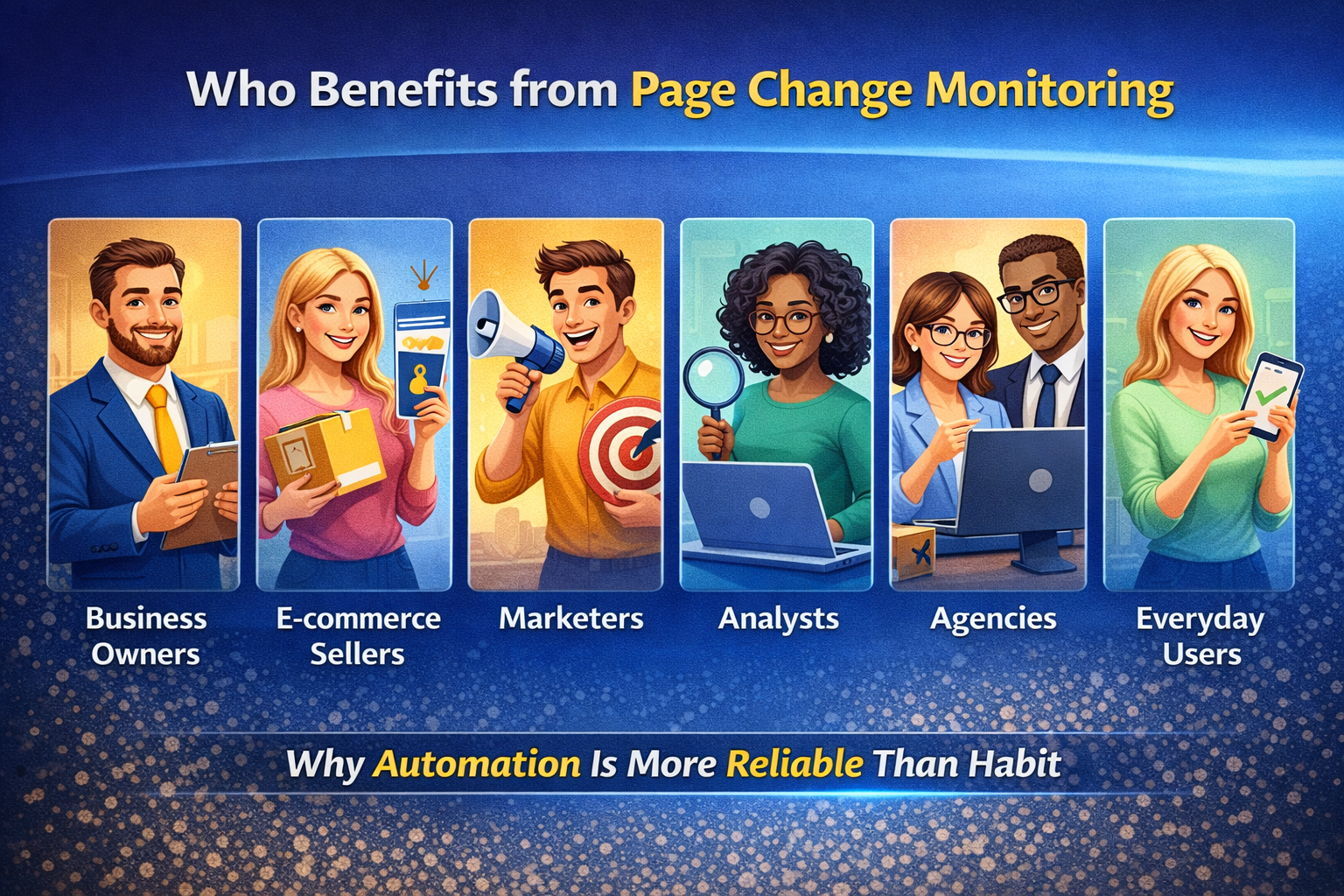
Yes, technical teams can use it. But so can business owners, marketers, researchers, e-commerce sellers, agencies, analysts, operations teams, and everyday users who simply care about important pages on the web.
That is because page change monitoring is not really about code. It is about awareness.
If a page matters to you, and a change on that page would matter to you, then page change monitoring can be useful.
Common real-world uses for page change monitoring
Watching competitor pricing and offers
This is one of the clearest use cases.
If you sell products or services online, competitor pages can influence your pricing, positioning, offers, and timing. A competitor might lower a price, change a package, add a promotion, remove a feature, or reposition their messaging. Those changes can affect your market faster than you expect.
Instead of checking those pages manually every day, you can monitor them and get notified when something changes.
That makes your response more timely and your decisions more informed.
Tracking stock and availability changes
If you rely on supplier pages, retailer pages, or product availability pages, then page changes can have direct business consequences.
A product can move from available to out of stock. Delivery timelines can shift. Product descriptions can change. Important availability signals can appear quietly. If you depend on that information, you should not have to keep checking manually to catch it.
Page change monitoring helps you stay aware of those updates without turning that process into a full-time habit.
Monitoring your own important public pages
Page change monitoring is not only for pages you do not control. It is also useful for pages you do control.
Your pricing page, service page, landing pages, docs, feature pages, and policy pages all shape how visitors understand your business. If something changes unexpectedly, you want to know. Maybe a content edit was wrong. Maybe a public page no longer says what you intended. Maybe something was updated and should be reviewed quickly.
When your public pages matter to trust, conversions, or clarity, page change monitoring gives you another layer of visibility.
Following public notices and policy updates
Some pages matter because they carry public information that affects your decisions.
This could be an announcement page, a policy page, a regulatory notice, a school page, a public institution page, or any page where updated wording or timing matters. In these cases, even a small change can be important.
Page change monitoring helps you keep watch without depending on memory or repeated checking.
Watching messaging shifts in the market
Sometimes what matters is not pricing or stock. Sometimes it is messaging.
A headline changes. A feature description changes. A landing page is rewritten. A value proposition shifts. A new promise appears. A certain offer disappears. Those changes can tell you a lot about how a competitor, supplier, or company is repositioning itself.
For marketers, researchers, analysts, and founders, that kind of signal can be highly valuable.
Staying aware without wasting time
Sometimes the most important benefit is simple: saving attention.
Not every useful workflow needs to feel dramatic. A lot of value comes from reducing repetitive checking and replacing it with a more dependable system. Page change monitoring helps you stop spending mental energy on “let me check again” and move toward “I will know when I need to know.”
That alone can make your workflow feel cleaner and more controlled.
What kind of pages are worth monitoring?
A page is worth monitoring when a change on that page would matter.
That usually includes pages like:
- pricing pages
- stock or availability pages
- product pages
- service pages
- public policy pages
- competitor landing pages
- important announcement pages
- pages that influence business, research, buying, or timing decisions
The best pages to monitor are not always the pages that change the most. They are the pages whose changes matter the most.
That is an important difference.
What page change monitoring is not for
Page change monitoring is valuable, but it is not meant to solve every monitoring problem by itself.
If your main concern is whether a website or endpoint goes down, uptime monitoring is the better fit.
If your concern is certificate validity and browser trust warnings, SSL monitoring is the better fit.
If your concern is whether a scheduled process or background job actually runs, heartbeat monitoring is the better fit.
If your concern is DNS records, domain expiry, email setup, SEO checks, or security headers, those need their own appropriate monitoring too.
That is exactly why we built Watchtower to cover more than one kind of monitoring. Different risks need different kinds of visibility. Page change monitoring is powerful, but it becomes even more useful when it sits inside a broader monitoring setup instead of standing alone.
Why manual checking is not enough for growing needs
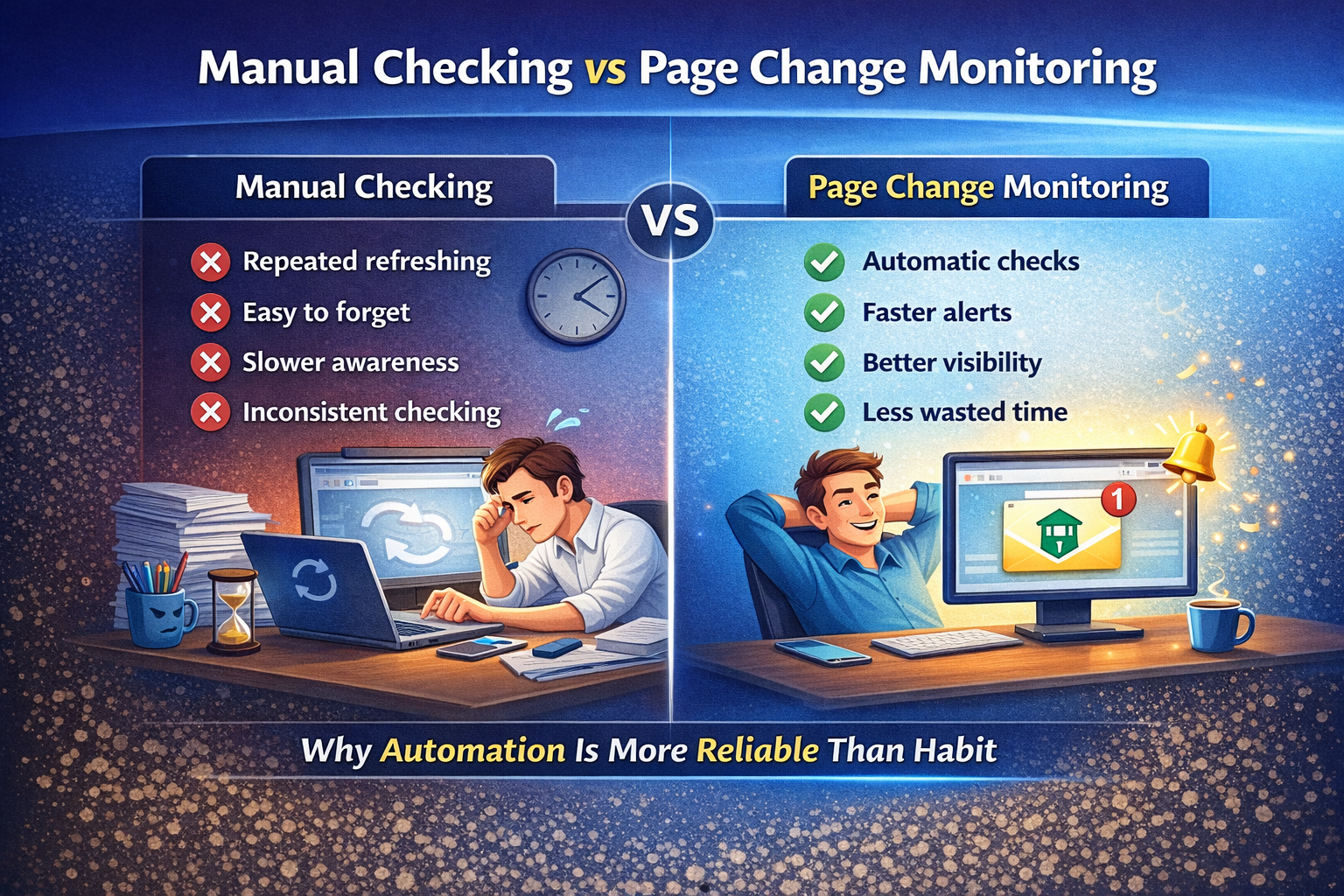
At the beginning, manual checking feels manageable.
You open a few tabs. You refresh a few pages. You keep a few important pages in mind. It feels small and simple.
But as your responsibilities grow, that method becomes unreliable.
You start watching more pages. More changes matter. More timing matters. More decisions depend on updated information. Suddenly, manual checking is no longer simple. It becomes inconsistent. It becomes easy to delay. It becomes easy to forget.
That is usually the point where people realize they do not just need access to information. They need a better system for staying aware of it.
Page change monitoring gives you that system.
Why this matters for businesses
For businesses, page change monitoring is not just about convenience. It is about visibility.
When important information changes on the web, the speed at which you notice can shape the speed at which you respond. That can affect pricing decisions, campaign reactions, competitor awareness, public communication, inventory planning, customer trust, and more.
The earlier you notice a meaningful change, the more options you usually have.
That is why page change monitoring can be valuable for:
- founders trying to stay aware of market movement
- operations teams watching critical public pages
- e-commerce sellers tracking offers and stock
- agencies monitoring client-relevant pages
- researchers following evolving information
- marketers watching shifts in public messaging
The use cases are broader than many people think because the underlying need is broad too: knowing when something important changed.
Why this matters for individuals too
Page change monitoring is not only for companies.
Sometimes an individual simply needs to know when a public page changes. That could be a page related to pricing, availability, a notice, an update, a requirement, or some other information they care about enough to check repeatedly.
In those cases, page change monitoring replaces repetition with peace of mind.
You do not have to keep going back to the page just in case something changed. You can let the monitoring do the watching for you.
How to think about starting
The best way to start is not by monitoring everything.
Start with the pages that would matter most if they changed today.
Ask yourself:
Which page would affect my decisions the most if it changed unexpectedly?
Which page do I check over and over?
Which page do I never want to miss an update on?
That is usually where the value becomes obvious first.
Once you see how useful that visibility is, you can expand from there.
Why we built this into Watchtower
At Watchtower, we believe monitoring should be practical, clear, and usable in the real world.
That is why page change monitoring is part of a broader monitoring platform instead of being treated like an isolated trick. In real use, people often need more than one kind of visibility. They may need to watch a public page for content changes, monitor a site for uptime, watch certificate expiry, keep an eye on DNS, or track whether scheduled jobs are still running.
Those are different problems, but they are connected by one bigger need: knowing what is happening before issues become more expensive.
Page change monitoring is one of the most useful ways to close that gap.
Final thought
Page change monitoring is for more than detecting edits.
It is for staying aware.
It is for reducing blind spots.
It is for protecting decisions.
It is for reacting faster when important pages shift.
It is for replacing repeated manual checking with something more dependable.
When a change on a page can affect what you do next, waiting to notice it later is rarely the best strategy.
That is why page change monitoring matters.
And that is what it is for.